









Galvanic currents and submersible pumps
|
Cours of stray currents
of an uncoupled submersible pump
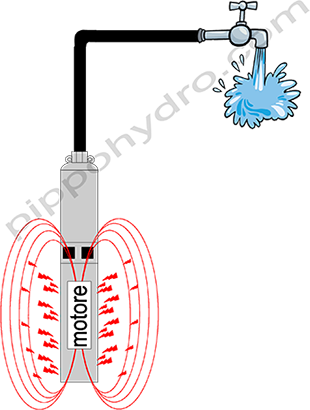
|
Cours of stray currents
of a close coupled submersible pump
|
Cours of stray currents
of an uncoupled submersible pump with a motor protection
|
|---|
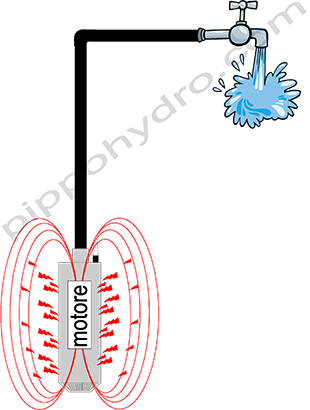
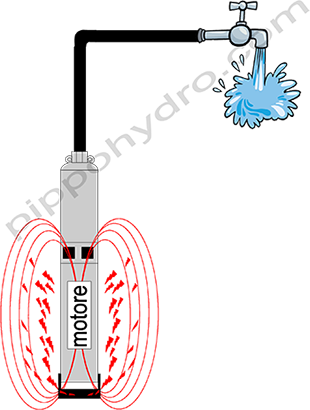

One of the most frequent causes of faults in submersible pumps, in pipes, in hydraulic accessories but also in endothermic engines is represented by galvanic currents, also called stray electrical currents. Galvanic current occurs in the presence of two or more dissimilar metals in an electrolyte or water environment.
Galvanic currents, even if of small intensity, can breaking up the molecules of metals, moving them from one point to another of the metal structure, irremediably weakening its lift.
The seriousness of the frequent problems encountered, has led to the search for stable solutions that can significantly reduce the damage due to this phenomenon.
The motor, the boats and the parts subjected to this danger are equipped with cathodic protections. The function of this protection will be discuss going forward in this brief explanation, in order to solve the most common problems that arise in the field of submersible pumps and piping.
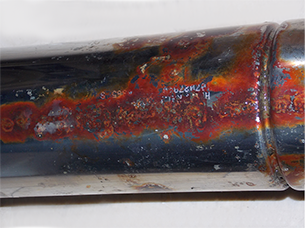
In the cylinders of the endothermic engines there are often holes that pierce the metal: it seems that the rubbing between the piston and the cylinder facilitates the phenomenon. Pure magnesium plates are inserted into the containment chamber to protect the motors.
The potential difference generated between metals facilitates the action of molecular disintegration. In submersible pumps, the phenomenon is even amplified both by the magnetic field induced by the motor and by the fact that the motor is totally immersed in water. In this last case the conductivity of the water catalyzes the power of the currents, greatly increasing the effect.
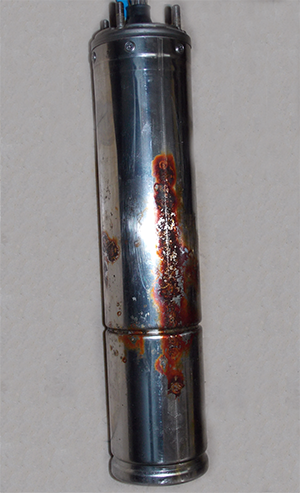
The action of stray currents can act in a very short period of time to damage metals, irreparably damaging the insulation or delicate parts of the motor. The figure at the side shows the damage due to stray currents on a submerged engine after 3 months of operation with water with a high iron content.
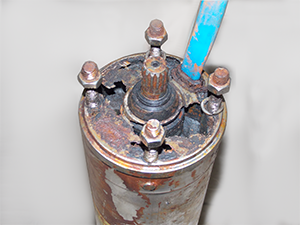
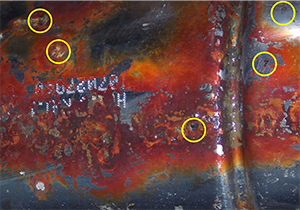 The ferrous charge present in the water causes the deterioration of the motor.
Since, in general, the intensity of the stray currents that invests the metallic artefact is more intense than that generated by electrochemical phenomena, the effect of corrosion is more accentuated.
The figure on the right clearly shows a motor in which the galvanic protection was located between the pump and the motor. The protection slowed down the damage to the engine but could not prevent its corrosion.
 Solutions:
The phenomenon can be slowed down or even avoided by inserting anodic protections that attract the electrical potential towards them.
Protectors in magnesium or cast iron with low carbon content, they oppose a low resistance to water and therefore to the induced magnetic fields, they attract to if the electrochemical ionization process.
A good technique is to use electropumps built with quality steels, plastic or stainless steel AISI 316 and insert protectors to equalize the action of the induced magnetic fields.
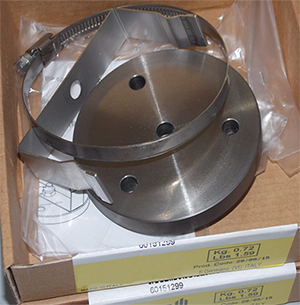
Excellent results have been achieved by using also anticorrosive disk protectors. With this protection the disk is kept at a safe distance from the motor. The disk protection generates the potential difference and attracts to the induced motor currents.
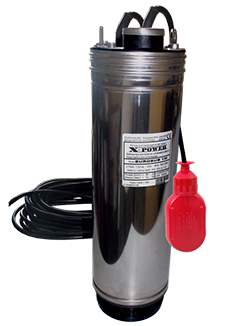
 Excellent results have been achieved even more by using X-POWER Watercooled submersible pumps with resins motor.
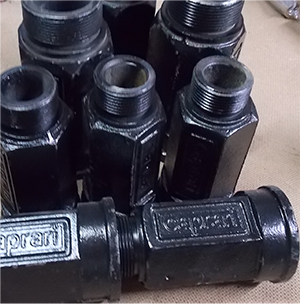
In the image on the right, the Caprari cast-iron anode for the cathodic protection of the submersible pump against stray currents.
These currents can be aggressive towards the pump metal. They are attracted by the thick protective joint that is installed right in the pump outlet. The 1" 1/4 and 2" joints are available on Pippohydro to cover the Caprari E4XED and E4XP range.
For assembly it is sufficient to screw the threaded protector to the submerged pump outlet.
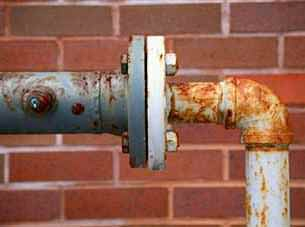
As you can see in the image on the left, the phenomenon of galvanic currents is also fully manifested in metal pipes, especially if they are buried.
In the same way, in these cases, a potential difference is created between the metal and the materials of different ionic charge present in the ground.
For example, the current dispersed by train rails, is attracted by the present humidity, dragging together electrically charged particles of metal (ions). Even in the pipes, holes are formed which are split off by the ionization located in the walls of the pipes.

Submersible pumps and submersible motors for wells
Close-coupled monoblock submersible electric pumps
Lifting system for well with submersible pump and inverter
Connections for submersible pump with water passage inverter
Single-phase submersible pump system with wall inverter
Well water system with submersible pump and presscontrol
Well water system with submersible pump and pressure vessel
Damages and possible problems in water systems
How to install monoblock (close-coupled) pump?
If you are having difficulty in locating something on our website,
please

The pippohydro.com website is dedicated to all those who want to save money finding the best products on the market; for DIY lovers; to customers who seek, verify and find the solution that suits their needs.